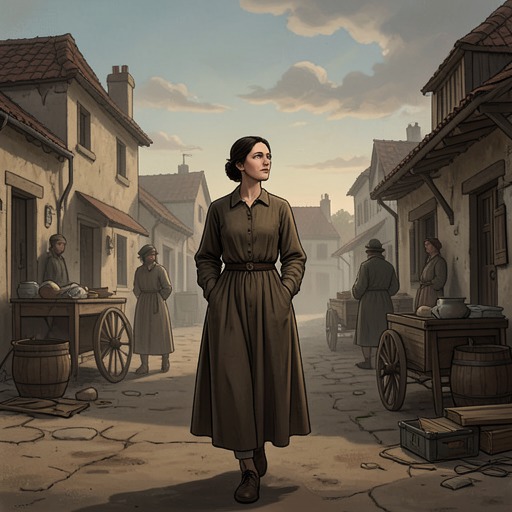
Escolástica
Love in the Time of CholeraEscolástica is Fermina Daza’s aunt, but her place in Fermina’s life is closer to that of a mother and trusted confidante. She raises the girl after Fermina’s mother dies and, despite living under Lorenzo Daza’s authority, becomes the crucial ally of Fermina’s first love with Florentino Ariza. Her practical ingenuity makes the secret courtship possible; her expulsion from the family home reveals the cost of that assistance and leaves a lasting mark on Fermina’s memory.
Family and Place in Fermina’s Life
Escolástica arrives in the story as the older woman reading with Fermina in the sewing room of the family house. A passing observer initially takes her for the girl’s mother, an understandable mistake: she has raised Fermina as her own since the death of Fermina’s mother. She is forty, unmarried, and performs a vow by wearing the habit of Saint Francis in the street and a penitent’s cord at home. Her religious dress and austere conduct do not prevent her from having a strong instinct for human attachment. In Fermina’s isolated childhood, Escolástica supplies the understanding and affection missing from the girl’s parents’ marriage.
The two women share a daily routine that brings them through the Park of the Evangels. When they repeatedly see Florentino sitting beneath the trees, Escolástica recognizes that his presence is intentional and treats the young man’s apparent reserve as a sign of love. Fermina, by contrast, initially feels pity for him and thinks he may be ill. Escolástica interprets his watching as evidence that he is lovesick, and her amused confidence turns the repeated sightings into a private diversion shared with her niece. She understands that Lorenzo’s household rules make open courtship impossible, and she encourages the possibility that Florentino may eventually approach Fermina with a letter.
Making the Secret Courtship Possible
Escolástica’s help is not merely sympathetic; it gives the courtship its working methods. Anticipating the obstacles of forbidden love, she teaches Fermina sign language. The lesson makes their glances and gestures part of a private code, even though Fermina does not at first understand how far her curiosity will carry her. As her interest grows into an urgent need to see Florentino, she longs for a letter from him. Her aunt’s encouragement gives that desire a trusted setting, but the secrecy and uncertainty of the exchange also intensify it.
After carrying Fermina’s first letter to the telegraph office, Escolástica permits an almost daily exchange of messages, arranged to look like casual encounters in the street. She still will not allow the two young people to speak, even briefly. She fears that a conversation might expose them, and she knows her position is precarious: her only means of support is Lorenzo’s charity, while his tyrannical nature would not forgive what he would regard as a betrayal. Yet when she sees that Fermina’s attachment is no passing girlish fancy, she cannot bring herself to cause her niece the same kind of lasting grief that she herself has been made to bear. She therefore allows the correspondence to continue under a system designed to preserve the appearance of innocence.
The arrangement moves the danger away from direct meetings and into hidden places. Fermina leaves letters along her route from home to the Academy and names a place where Florentino can leave his reply; he does the same. Their messages pass through church baptisteries, holes in trees, and cracks in ruined colonial fortresses. Some are damaged by rain and mud, torn, or lost, but the young couple repeatedly find ways to resume contact. Escolástica’s complicity thus becomes the practical infrastructure of a relationship that, during its first months, is sustained by letters rather than private conversation.
Discovery and Expulsion
The secret is uncovered after Sister Franca de la Luz, superior of Fermina’s Academy, catches her writing a love letter during class. The Academy treats the letter as grounds for expulsion. Fermina admits what she has done but refuses to identify her sweetheart, including when questioned by the religious tribunal. Lorenzo then searches his daughter’s room and finds packets of letters hidden in the false bottom of her trunk. Their signatures reveal Florentino’s identity and make the scale of the correspondence impossible to dismiss.
Convinced that his sister must have helped, Lorenzo does not offer Escolástica an excuse or an appeal. He sends her away on a schooner to San Juan de la Ciénaga. Fermina’s last image of her aunt is of her leaving the doorway feverish beneath her brown habit, then disappearing into the drizzle in the park with her sleeping mat and a month’s money wrapped in a handkerchief. The plainness of what she carries underscores how suddenly her home and security have been taken from her. Fermina responds to the punishment with fierce grief: she shuts herself in her room and refuses food and drink. Lorenzo’s attempt to restore order by persuasion and promises fails; Fermina will not accept the sacrifice of the woman she has always associated with her dead mother.
Lasting Absence and Narrative Significance
Once free of her father’s authority, Fermina searches the Caribbean provinces for Escolástica, asking anyone who might know where she has gone. She finds no trace of her for nearly thirty years. Only then does a letter, passed through many hands, tell Fermina that her aunt died in the Water of God leprosarium. The delayed news gives the separation a long afterlife: Escolástica is absent from Fermina’s household, but the loss remains part of the history through which Fermina understands family, loyalty, and her first love.
Escolástica’s role also shapes the novel’s contrast between private feeling and public control. The couple’s courtship depends on coded gestures and letters concealed along ordinary routes, while the institutions around Fermina—the household and the Academy—treat the correspondence as a punishable breach. Escolástica understands both the danger and the emotional importance of helping, and her choice to protect Fermina costs her a home. Decades later, Fermina’s cousin Hildebranda Sánchez recalls Escolástica’s expulsion as one of the injuries that still binds the women’s memories of their youth. Through Escolástica, the first romance is shown not as a private exchange between two young people alone, but as an attachment made possible by an older woman’s care and made costly by the authority she defies.